The Context of Household Water Use in Canada
Canadian households are among the higher per-capita water consumers among developed nations, largely due to the widespread assumption of abundant freshwater availability. Statistics Canada and Environment and Climate Change Canada have published periodic data on residential water consumption, with indoor use typically distributed across toilets (the largest single use in older homes), showers and baths, laundry, and kitchen and bathroom faucets.
Outdoor water use — principally garden irrigation — can represent a disproportionately large seasonal draw in drier inland provinces such as Alberta and Saskatchewan, where summer evaporation rates are high and natural precipitation does not sustain lawns or vegetable gardens without supplementation.
Indoor Water Conservation
Toilet Upgrades
Toilets manufactured before 1994 typically used 13–20 litres per flush. The current Canadian standard (governed by the Canadian Standards Association CSA B45 series) requires new toilets to use no more than 6 litres per flush (LPF). High-efficiency toilets (HETs) certified under the WaterSense standard use 4.8 LPF or less. Dual-flush toilets offer a reduced-volume option for liquid waste, typically at 3 litres, and a full flush at 6 litres.
For households with older toilets, replacement represents one of the most straightforward paths to significant water reduction. Several Canadian utilities have historically offered rebates for toilet replacement, including the City of Toronto's former Toilet Replacement Program and similar schemes in Calgary and Halifax.

A low-flow showerhead. Flow-restricted showerheads can reduce shower water use substantially versus older models. Source: Wikimedia Commons (CC)
Showerheads and Faucet Aerators
Standard showerheads manufactured before efficiency regulations commonly flowed at 9–12 litres per minute. Current low-flow models are rated at 5.7–7.6 litres per minute (1.5–2.0 gallons per minute). Replacing a showerhead is among the lowest-cost hardware interventions available, with units widely available in Canada for under CAD $40.
Faucet aerators — screen inserts that mix air into the water stream — reduce faucet flow from a typical 8–12 LPM to 4–6 LPM without a perceived change in pressure for most uses. They screw onto standard threaded faucet spouts and cost under CAD $10 each.
Washing Machines
Front-loading washing machines use substantially less water per cycle than older top-loading agitator models. Natural Resources Canada's ENERGY STAR certification for clothes washers includes a water factor (WF) rating. Models with lower WF scores use less water per litre of drum volume. For a typical Canadian household running four to six loads per week, switching to an ENERGY STAR certified front-loader represents measurable annual water savings.
Dishwashers
Certified dishwashers are more water-efficient than hand-washing for full loads. The condition of a full load is important: running a dishwasher with a partial load partially offsets the efficiency benefit. ENERGY STAR certified dishwashers are required to use no more than a set threshold of litres per cycle under test conditions.
Leak detection: A running toilet or dripping faucet can waste thousands of litres per month. To check for toilet leaks, add a few drops of food colouring to the tank and wait 15 minutes without flushing. If colour appears in the bowl, the flapper or fill valve may need replacement — a low-cost fix available from any Canadian hardware retailer.
Outdoor Water Conservation
Irrigation Timing and Method
In Canada's prairie provinces and the interior of British Columbia, outdoor watering accounts for a substantial share of peak summer residential water demand. Municipal water utilities in cities such as Lethbridge, Red Deer, and Kelowna have implemented tiered pricing and odd/even day watering restrictions during summer months to manage peak demand.
Watering in the early morning — before 9:00 AM — reduces evaporation loss compared to midday watering. Evening watering is generally discouraged in humid climates due to the increased risk of fungal disease on grass and ornamental plants.
Drip Irrigation
Drip irrigation systems deliver water directly to the root zone of plants through emitters on low-pressure tubing. They are particularly effective in vegetable gardens and raised beds where precise delivery reduces both water loss through evaporation and weed promotion from broad-area wetting. Drip systems can be connected to a timer and integrated with a rain barrel or above-ground collection tank.
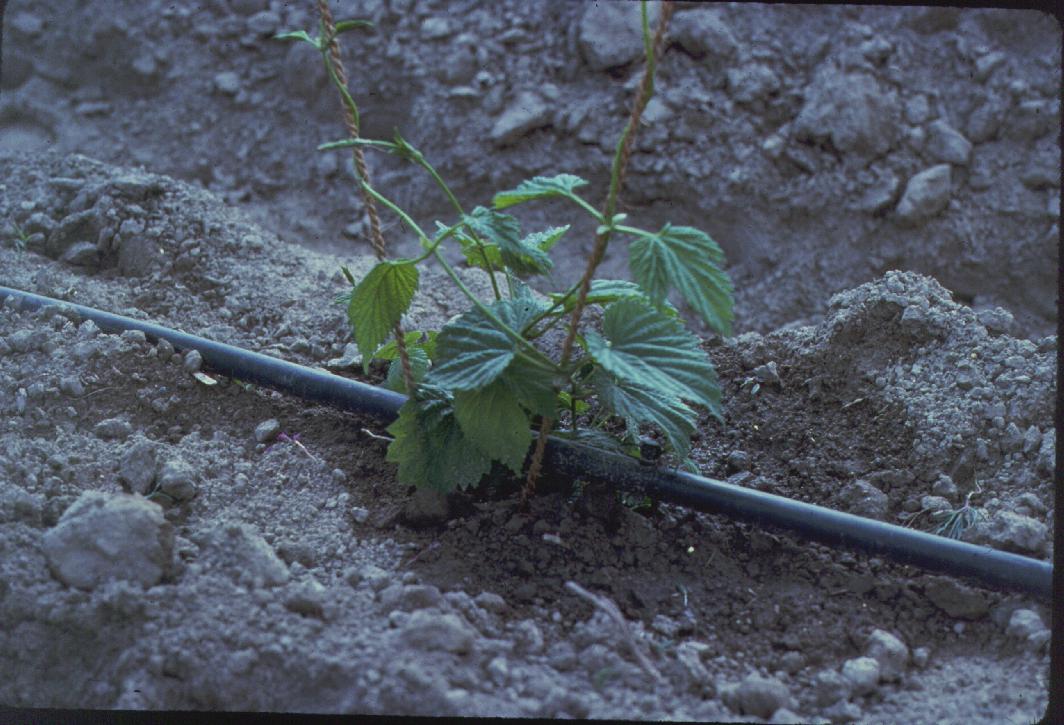
Drip irrigation delivers water directly to plant root zones, reducing overall consumption compared to overhead sprinklers. Source: Wikimedia Commons (CC)
Lawn Choices and Xeriscape
Conventional turf grass — particularly Kentucky bluegrass and fescue varieties common in Canadian suburban lawns — has high water requirements in dry summers. Alternatives that have been documented in Canadian municipal guides include:
- Buffalo grass — drought-tolerant, suited to Prairie provinces, lower mowing frequency needed
- Fine fescue blends — lower water requirements than bluegrass, suited to shadier areas
- Clover lawn mixes — nitrogen-fixing, stays green in moderate drought conditions without irrigation
- Native perennial gardens — once established, rely primarily on natural precipitation; supported by various municipal naturalization bylaws
- Gravel and permeable hardscape — eliminates irrigation need while managing stormwater runoff
The City of Calgary and the City of Regina have both published xeriscape guides specifically tailored to their climate conditions and native plant species.
Rain Gardens and Bioswales
Rain gardens are shallow, planted depressions designed to capture and infiltrate stormwater runoff from impervious surfaces such as driveways, rooftops, and patios. They are planted with deep-rooted native species that tolerate both temporary inundation and dry periods between rain events. Bioswales serve a similar function at a larger scale, often along roadways or property boundaries.
Several Canadian municipalities — notably in the Greater Toronto Area, Metro Vancouver, and Ottawa — have incorporated residential rain garden programs into their stormwater management strategies. These features reduce the volume of water entering the combined sewer system during storm events, which has implications for municipal infrastructure costs.
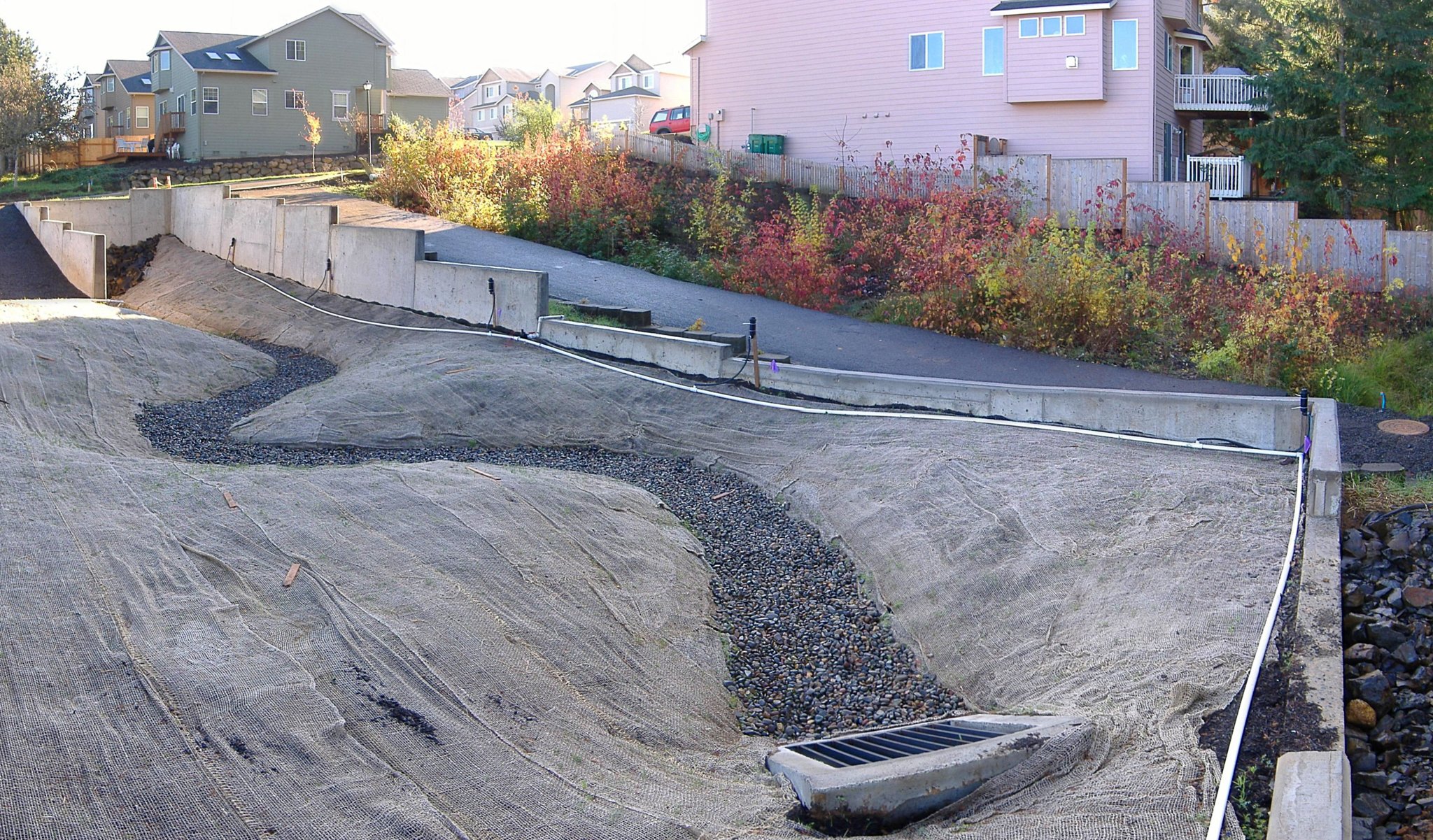
A bioswale planted with native species, used to capture and filter stormwater runoff. Source: Wikimedia Commons (CC)
Conservation Summary by Measure
| Measure | Typical Upfront Cost (CAD) | Approximate Annual Savings |
|---|---|---|
| Faucet aerators (per tap) | $5–$15 | Moderate indoor savings |
| Low-flow showerhead | $20–$60 | Moderate-to-high indoor savings |
| Dual-flush toilet | $150–$500 installed | High indoor savings (older homes) |
| ENERGY STAR front-load washer | $700–$1,400 | Moderate indoor savings |
| Rain barrel + diverter | $30–$120 | Moderate outdoor savings (seasonal) |
| Drip irrigation system | $50–$300 for garden-scale | High outdoor savings in dry climates |
| Native lawn replacement | $500–$5,000 (varies by area) | Very high outdoor savings long-term |